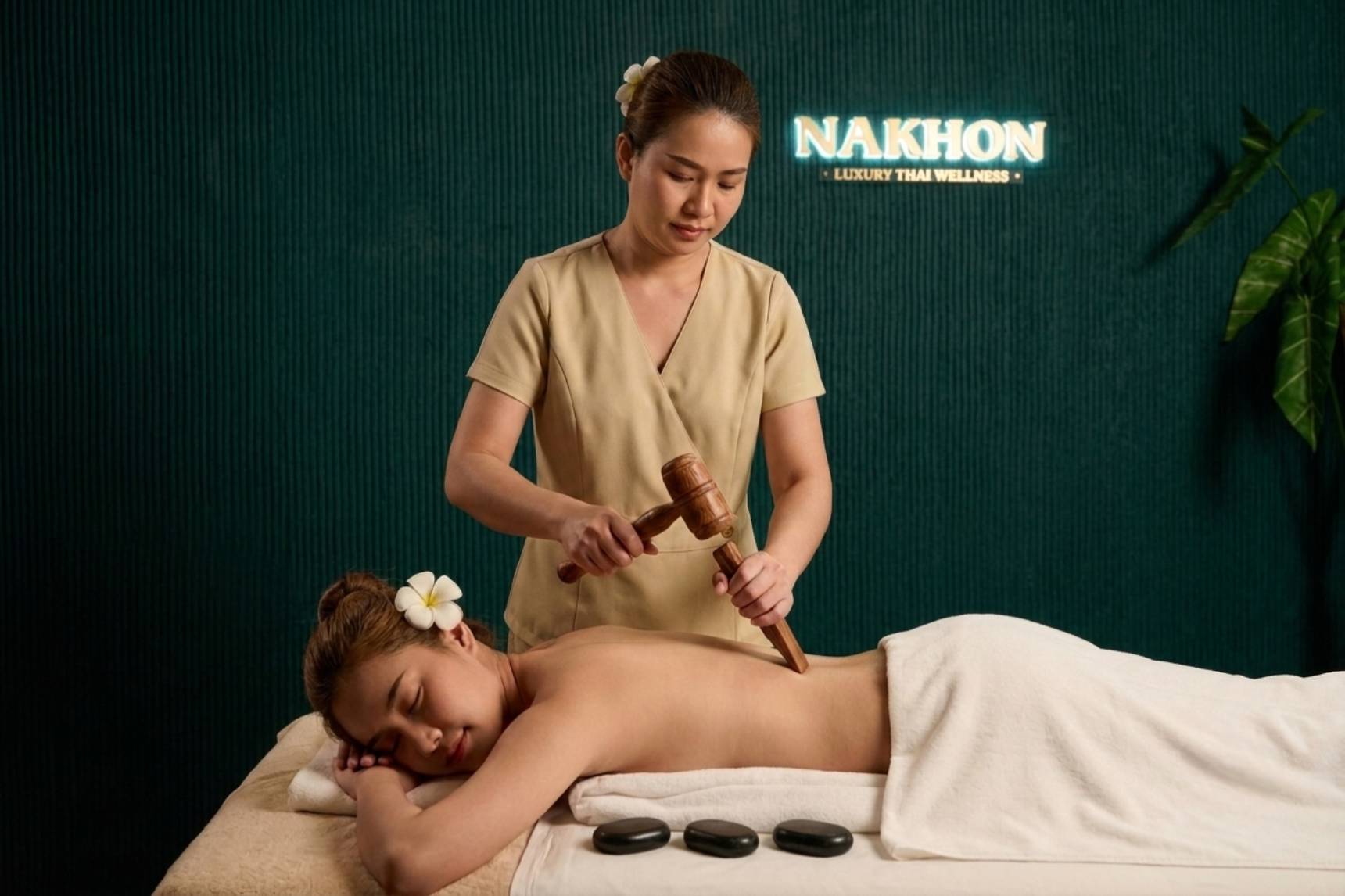
If you were to walk through the serene, incense-scented corridors of a traditional healing center in Northern Thailand, you might hear a sound that stands out from the familiar ambient spa music. Beneath the gentle chime of meditation bells and the rustle of silk, there is a rhythmic, almost hypnotic percussion: tok, tok, tok.
To the uninitiated, the sound of wooden tools gently striking one another might seem out of place in a massage room. However, for those who have experienced the profound relief of this ancient practice, that rhythmic tapping is the sound of deep, restorative healing.
Welcome to the world of Tok Sen, a beautifully unique and highly effective modality of bodywork that remains one of Thailand’s best-kept wellness secrets. Here at Nakhon Spa, we believe that true wellness comes from understanding and honoring the roots of ancient medicine while applying it to our modern aches, pains, and stressors. While traditional Thai massage has rightfully earned its place on the global stage, Tok Sen remains a rare discovery for many spa-goers.
In this comprehensive guide, we are going to journey deep into the heart of the Lanna Kingdom to explore the origins, the science, and the spiritual magic behind Tok Sen therapy. Whether you are a massage aficionado looking for your next holistic discovery, or someone struggling with stubborn muscle tension that traditional techniques cannot quite reach, this is everything you need to know about the ancient wood-tapping therapy.
The Roots of the Rhythm: A Journey to the Lanna Kingdom
To truly understand Tok Sen, we must travel back in time to the ancient Lanna Kingdom, which flourished in what is now modern-day Northern Thailand, particularly around the cultural hub of Chiang Mai. The word "Lanna" translates to "The Land of a Million Rice Fields," a poetic moniker that paints a vivid picture of the region's agrarian history.
It is within these vast, emerald-green rice paddies that Tok Sen was born.
Hundreds of years ago, the farmers of the Lanna Kingdom worked grueling days under the hot tropical sun. The repetitive, back-breaking labor of planting and harvesting rice left them with severe muscle stiffness, deep fascial knots, and chronic joint pain. Traditional Thai massage, which relies heavily on the therapist's thumbs, palms, and body weight to apply pressure, was sometimes not enough to penetrate the dense, deeply fatigued muscles of these laborers. Furthermore, the healers themselves found it physically exhausting to apply the massive amount of pressure required to help these farmers.
Necessity, as they say, is the mother of invention. The local Buddhist monks, who served as the primary healers and doctors of their communities, developed a brilliant solution. They turned to the natural resources around them—specifically, the dense, resonant wood of local trees—to create tools that could amplify their healing efforts.
The name of the therapy perfectly describes the action. In the Thai language, "Tok" refers to the physical action of tapping or striking something, while "Sen" refers to the energy pathways that run throughout the human body. Therefore, Tok Sen literally translates to the act of tapping the energy lines.
Fun Fact & Discovery: In ancient times, the tools used for Tok Sen were not just carved from any piece of wood. Master healers would venture into the forests to find a tamarind tree that had been struck by lightning. According to animist and traditional Lanna beliefs, a lightning-struck tree had absorbed the immense, raw energy of the sky and the heavens. The wood from this tree was considered sacred, naturally infused with vibrational power that could drive out negative energy and physical blockages from the human body.
The Anatomy of Energy: Understanding the "Sen Sib"

You cannot fully grasp the power of Tok Sen without understanding the foundational philosophy of Thai traditional medicine: the concept of the Sen lines.
Similar to the "prana" or "nadis" in Indian Ayurvedic medicine, or the "qi" and "meridians" in Traditional Chinese Medicine, ancient Thai healing is built upon the belief that a vital life force—known as Lom Pran—circulates through the body along invisible pathways. Thai medicine maps out 72,000 of these energy pathways, but focuses primarily on the ten major ones, collectively known as the Sen Sib.
These ten major lines begin around the navel and radiate outward, traveling through the deep tissue, muscles, and fascia, finally terminating at various points on the face, hands, and feet. When a person is healthy, the life force flows through these Sen lines smoothly and unobstructed, much like a clear, flowing river.
However, modern life is full of obstacles. Physical trauma, poor posture, repetitive strain, emotional stress, and even poor diet can create "dams" or blockages within these rivers of energy. When a Sen line becomes blocked, the stagnation manifests as physical pain, stiffness, nerve issues, and even emotional imbalances like anxiety or lethargy.
In traditional Thai massage, the therapist uses acupressure and deep stretching to unblock these lines. But when a blockage is buried deep within thick muscle tissue or trapped beneath layers of tight fascia, fingers and thumbs simply cannot reach it without causing the client significant pain. This is where the mechanical genius of Tok Sen comes into play.
The Mechanics of Tok Sen: Where Ancient Tradition Meets Modern Science
While the origins of Tok Sen are steeped in spiritual tradition, modern physiological science offers a fascinating explanation for why this therapy is so incredibly effective. At its core, Tok Sen is a sophisticated form of vibrational therapy.
The Power of Mechanical Vibration
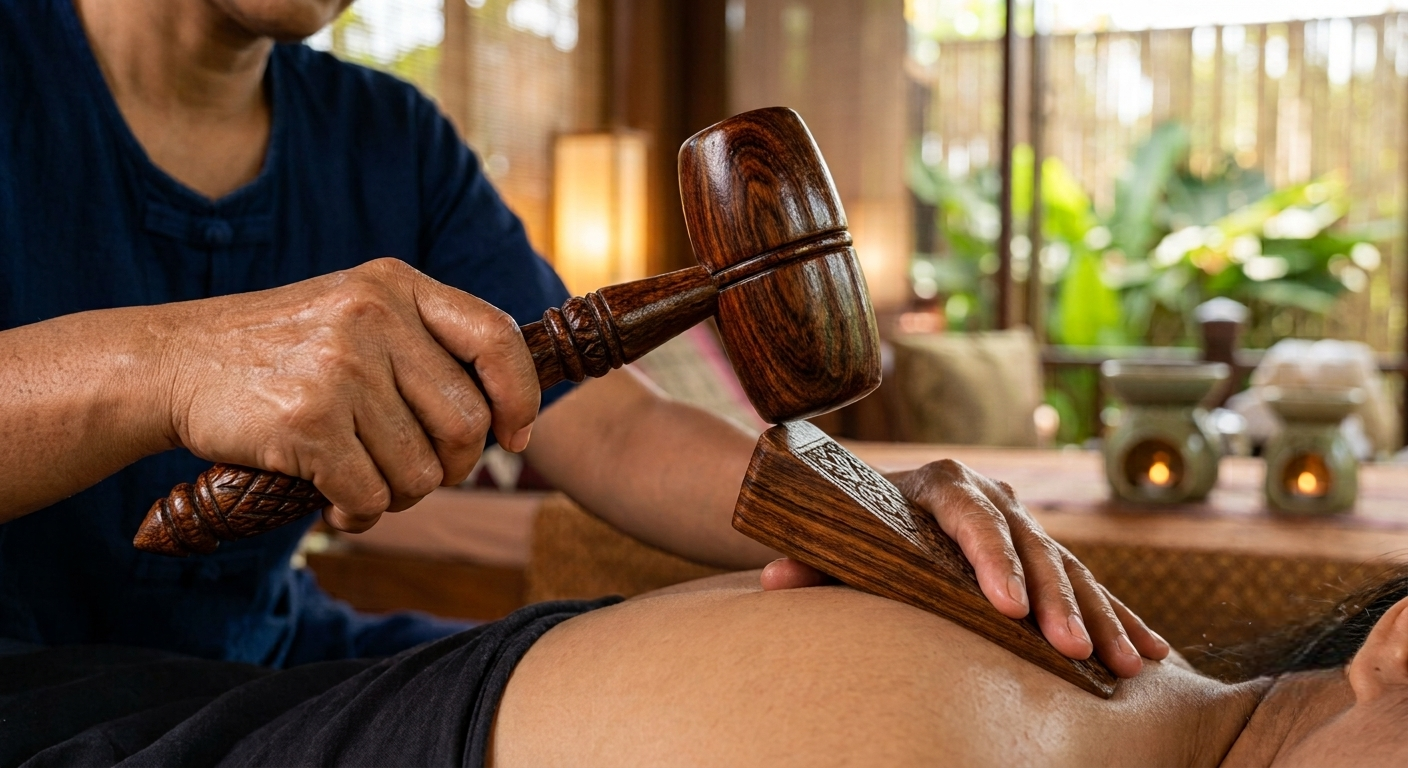
When the practitioner taps the wooden wedge with the mallet, it creates a mechanical vibration. Because human bodies are composed of roughly 60% to 70% water, we are excellent conductors of vibration. The rhythmic shockwaves generated by the wooden tools do not stop at the surface of the skin; they ripple downward, penetrating through layers of fat, muscle, and connective tissue, reaching all the way to the attachments at the bone.
Think of a pond. If you push your hand into the water (representing traditional deep tissue massage), you displace the water locally. But if you strike the surface of the water, you send a ripple that travels all the way to the bottom and out to the furthest shores. Tok Sen creates ripples of healing inside your body.
Unwinding the Fascia
Modern bodyworkers are incredibly focused on fascia—the tough, web-like connective tissue that encases every muscle, bone, and organ in the body. When fascia becomes tight or dehydrated, it acts like a straightjacket, causing chronic pain and restricting movement. Fascia is notoriously difficult to stretch manually, but it responds remarkably well to vibration. The continuous, rhythmic pulses of Tok Sen cause the rigid fascial fibers to vibrate, warm up, and eventually "melt" or release, restoring a massive amount of mobility to the recipient.
A Natural Precursor to the Massage Gun
It is impossible to discuss Tok Sen without drawing a modern parallel. In recent years, the fitness and wellness industries have been completely taken over by percussion therapy devices, commonly known as massage guns. Athletes and physical therapists use these battery-powered devices to pummel muscles and relieve soreness.
While massage guns are effective, they are a modern, motorized echo of what Lanna monks invented centuries ago. Tok Sen is, in essence, the original, acoustic percussion therapy. However, unlike a loud, motorized device that applies a robotic, uniform pummeling, Tok Sen is an artisanal practice. The practitioner uses their intuition, adjusting the angle, the force, and the rhythm of the tapping based on how the client's tissue feels and sounds. It is a profoundly human, connected experience that a machine simply cannot replicate.
The Sacred Tools of the Trade
The efficacy of Tok Sen relies entirely on the unique tools used by the practitioner. These tools are not mass-produced; they are hand-carved by artisans and blessed by monks, carrying a deep cultural significance.
There are two primary components to a Tok Sen toolkit:
- The Khone (The Mallet): This is the striking tool. It is typically a beautifully carved wooden hammer with a smooth, rounded head.
- The Lims (The Wedges/Chisels): These are the pieces that make direct contact with the body. A practitioner will have a variety of Lims in their toolkit. Some have a wide, flat edge for addressing large muscle groups like the back and thighs. Others have rounded, pointier tips for pinpointing specific trigger points around the scapula or along the spine. Some are even shaped like a "Y" with two prongs, designed specifically to straddle the spinal column or the Achilles tendon, delivering vibration to the muscles on either side without striking the bone itself.
The wood chosen for these tools is dense and heavy, ensuring a strong, clear vibration. Tamarind and Rosewood are the most common choices. Before a practitioner begins using a new set of tools, they are traditionally blessed in a temple ceremony, imbuing them with protective and healing intentions. At Nakhon Spa, we hold immense respect for the lineage of these tools, ensuring they are treated with the reverence they deserve.
The Sensory Journey: What to Expect During a Session
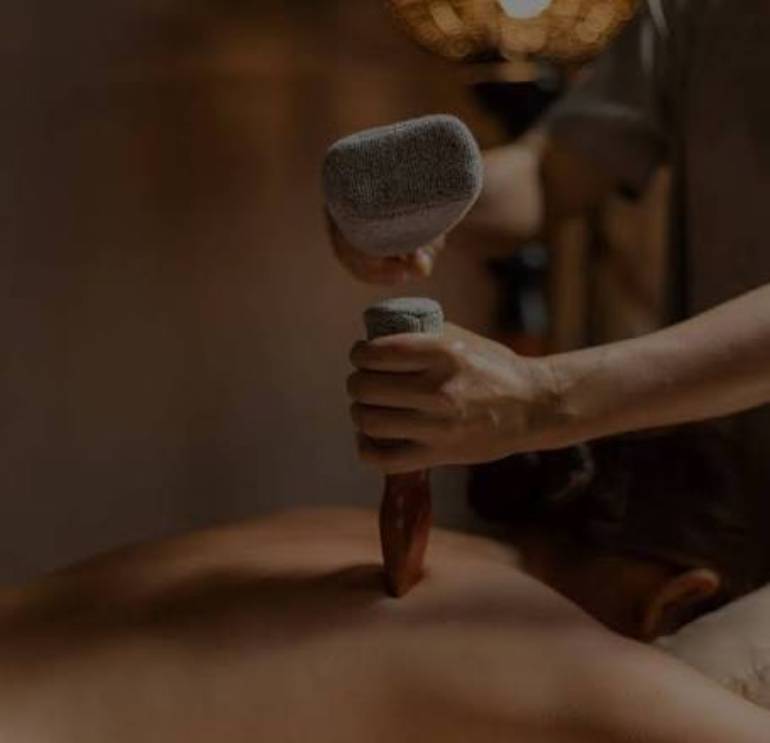
If you have never experienced Tok Sen before, you might feel a slight sense of trepidation. The idea of being tapped with a wooden mallet and chisel does not immediately sound relaxing to the Western ear. However, the experience is shockingly soothing. Here is what you can expect when you book a Tok Sen session at Nakhon Spa.
Setting the Stage
Similar to a traditional Thai massage, you will be provided with loose, comfortable clothing to wear during the session. The treatment takes place on a padded mat on the floor, allowing the practitioner to use their body weight and maneuver easily around you.
The Acoustic ASMR Experience
Before the physical sensation registers, you will notice the sound. The tok, tok, tok is not harsh or loud; it is a hollow, resonant, and deeply rhythmic clicking. Many clients report that this sound alone is deeply therapeutic. It mimics the steady rhythm of a heartbeat or the repetitive chanting of a mantra. Long before the internet coined the term "ASMR" (Autonomous Sensory Meridian Response), Tok Sen was providing this brain-tingling, deeply relaxing acoustic therapy. The sound lulls the brain out of its stressful "fight or flight" mode (sympathetic nervous system) and guides it into "rest and digest" mode (parasympathetic nervous system).
The Sensation of Deep Ripples
The practitioner will begin by warming up your body with traditional Thai massage techniques, using palm presses and gentle stretches to assess where your tension lies. Then, they will introduce the wooden tools.
They will place the edge of the Lim against a muscle—perhaps along the thick muscles of your calf or parallel to your spine—and begin tapping rhythmically with the Khone.
It does not hurt. In fact, it is entirely painless. You will feel a firm, rebounding pressure on the skin, followed by a sensation of vibration traveling deep inside your body. If the practitioner strikes a point on your shoulder, you might feel the ripple travel all the way down your arm to your fingertips. This indicates that the energy line is successfully conducting the vibration.
As the therapist moves along the Sen lines, you will feel deep, stubborn knots begin to surrender. Because the wood is doing the heavy lifting, your muscles do not naturally tense up to "fight" the pressure, which often happens during aggressive deep tissue massages. Your body remains relaxed, allowing the vibration to melt away years of accumulated tension.
The Transformative Benefits of Tok Sen
The benefits of this ancient practice are vast, bridging the gap between physical rehabilitation and mental relaxation. Because Tok Sen affects the body on a cellular and energetic level, the results are often felt long after you leave the spa.
For those suffering from chronic physical pain, Tok Sen offers unparalleled deep tissue and muscular relief. It is highly effective for individuals with tight shoulders, lower back pain, and stiff necks. The vibrations break up calcifications in the muscles and release the buildup of lactic acid, allowing the muscle fibers to elongate and heal.
It is also incredibly beneficial for joint mobility and nerve function. Conditions like sciatica, tennis elbow, and generalized neuropathy often stem from inflamed muscles compressing nerves. The targeted vibrations of Tok Sen help to decompress these areas, creating space for the nerves to function properly and reducing the sharp, shooting pains associated with nerve compression.
Beyond the muscular system, Tok Sen provides a massive boost to circulation and lymphatic drainage. The rhythmic striking acts as a mechanical pump for the blood vessels and lymph nodes. As blockages are cleared, fresh, oxygenated blood rushes into the stagnant areas, accelerating the body’s natural healing processes and flushing out cellular waste and toxins.
Finally, one must not overlook the profound mental and emotional benefits. In traditional Thai belief, trauma and negative emotions are stored within the body's fascia and energy lines. The hypnotic sound and the deep, releasing vibrations often prompt a deeply meditative state. It is not uncommon for clients to fall into a deep, restorative sleep during the treatment, waking up feeling not just physically lighter, but emotionally unburdened and mentally clear.
Who is the Ideal Candidate for Tok Sen?
Tok Sen is an incredibly versatile therapy, but it is particularly beneficial for certain individuals. You will likely find massive relief from Tok Sen if you:
- Suffer from chronic tension that standard massages cannot seem to resolve.
- Are an athlete or someone who engages in heavy physical labor, resulting in dense, fatigued muscles.
- Experience nerve-related pain, such as sciatica or carpal tunnel syndrome.
- Have a low tolerance for the pain associated with Western deep-tissue massages but still require deep muscular relief.
- Are seeking a deeply grounding, meditative spa experience that goes beyond simple pampering.
While highly beneficial, Tok Sen is a powerful therapy and there are a few contraindications. It should be avoided by individuals who are pregnant, those with severe osteoporosis, anyone with unhealed fractures or broken bones, and individuals with artificial joints or pacemakers. If you have a history of severe cardiovascular issues, it is always best to consult with your physician before trying a new vibrational bodywork therapy.
Experience the Rhythm at Nakhon Spa
The world of wellness is vast, but it is rare to find a treatment that so perfectly balances ancient spiritual tradition with profound physiological effectiveness. Tok Sen is more than just a massage; it is an acoustic, vibrational, and energetic reset for the mind and body. The tok, tok, tok of the wooden mallet is a call back to a simpler time, a rhythm that coaxes the body back into its natural state of harmony and flow.
At Nakhon Spa, we are passionate about preserving the authenticity of these ancient Lanna traditions while providing a luxurious, deeply relaxing environment for our guests. Our practitioners are highly trained in the precise art of tapping the Sen lines, ensuring that your experience is safe, incredibly effective, and tailored exactly to your body's unique needs.
You don't have to carry the weight of chronic tension and blocked energy anymore. It is time to let the ancient wisdom of Northern Thailand help you find your rhythm again.