
There is an undeniable magic to living in or visiting a tropical climate. The air is perpetually warm, the sun casts a golden hue over everything it touches, and the lush, vibrant environments feel like a constant embrace of summer. However, beneath the surface of that immediate, dewy glow lies a complex, microscopic battleground. Your skin, the body’s largest and most exposed organ, is constantly reacting, defending, and adapting to the intense environmental stressors unique to the tropics.
For many, the first signs of aging—fine lines, uneven pigmentation, and a loss of elasticity—seem to accelerate in these environments. This isn't just your imagination; it is an established biological reality. The combination of intense ultraviolet (UV) radiation, soaring humidity, extreme heat, and urban pollution creates what dermatologists call a "high-stress exposome" for the skin.
At Nakhon Spa, we believe that effective skincare goes far beyond mere pampering; it is rooted in a deep understanding of cellular biology. To truly protect and rejuvenate your complexion, you must first understand the mechanisms of how your environment interacts with your biology. Let us dive deep into the fascinating, invisible science of skin aging in a tropical climate.
The Ultraviolet Paradox and the Breakdown of Youth
When we talk about premature aging, the conversation must inevitably begin with the sun. While sunlight is essential for synthesizing Vitamin D and regulating our circadian rhythms, it is also the primary catalyst for skin aging, a process medically known as photoaging. In a tropical climate, where the sun is closer to the equator, the intensity of this radiation is magnified.
To understand photoaging, we must look at the two primary types of ultraviolet light that reach the earth's surface: UVA and UVB.
The Burning Ray: UVB
UVB rays are the shorter wavelengths of light. They only penetrate the outermost layer of the skin, the epidermis. These are the rays responsible for that immediate, painful sunburn you might get after a day at the beach without protection. While UVB causes direct damage to the DNA in your skin cells and plays a major role in the development of skin cancers, it is actually not the main culprit when it comes to long-term, visible aging.
The Aging Ray: UVA
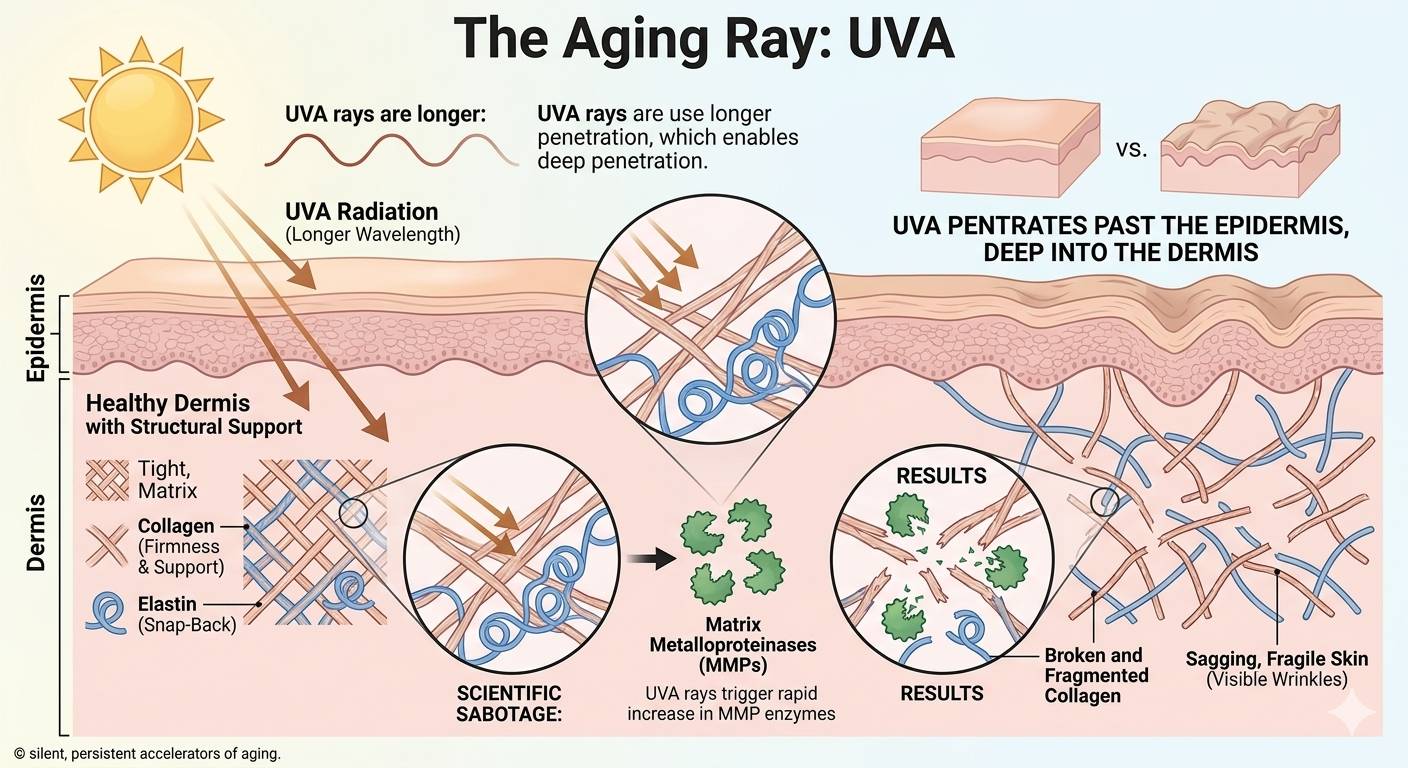
UVA rays are the silent, persistent accelerators of aging. They have a longer wavelength, allowing them to penetrate deep past the epidermis and into the dermis—the thick, foundational layer of the skin where your structural proteins reside.
Here is where the scientific sabotage occurs. Your dermis is held up by a tightly woven matrix of two critical proteins: collagen, which provides firmness and structural support, and elastin, which allows your skin to snap back into place after stretching. When UVA rays hit the dermis, they cause a rapid increase in the production of enzymes called Matrix Metalloproteinases (MMPs).
In a healthy system, MMPs are responsible for breaking down old, damaged tissue so new tissue can be formed. However, UVA radiation sends MMP production into overdrive. These enzymes begin aggressively chopping up perfectly healthy collagen and elastin fibers. To make matters worse, UVA exposure simultaneously inhibits the creation of new collagen. This dual-action assault leads to the microscopic collapsing of the skin's foundation, which eventually manifests on the surface as deep wrinkles, sagging, and a leathery texture.
Discovery Fact: UVA rays maintain the same level of intensity during all daylight hours throughout the year, regardless of the weather. Furthermore, they easily penetrate heavy cloud cover and standard window glass. If you are sitting indoors by a sunny window or driving a car without UV-coated glass, your dermis is actively accumulating photoaging damage.
The Heat Factor and the Science of Inflammation
While UV radiation gets most of the blame, modern dermatological science has uncovered another major factor in tropical skin aging: heat itself. Specifically, Infrared-A (IR-A) radiation, which we feel as the warmth of the sun.
In a tropical environment, the ambient heat is inescapable. When the skin is exposed to high temperatures, it triggers a cascade of physiological responses designed to cool the body down. The blood vessels in the skin dilate (vasodilation) to release heat, which is why your face might look flushed or red after a walk outside.
While sweating and vasodilation are critical survival mechanisms, chronic exposure to heat creates a state of low-grade, persistent inflammation in the skin. Inflammation is the body's alarm bell, and when it is constantly ringing, it accelerates the aging process—a phenomenon scientists now refer to as inflammaging.
Chronic heat exposure stimulates the very same collagen-destroying MMP enzymes as UV radiation. Furthermore, heat is a massive trigger for melanocytes, the cells responsible for producing pigment (melanin). When melanocytes are overheated and inflamed, they often overproduce melanin in a localized, chaotic manner. This is why individuals living in tropical climates frequently struggle with hyperpigmentation, stubborn sun spots, and melasma. You can be wearing the highest grade of sunscreen to block UV rays, but if your skin temperature drastically rises, you can still trigger the formation of dark spots.
The Humidity Illusion and Transepidermal Water Loss
One of the most counterintuitive aspects of tropical skincare is the relationship between humidity and hydration. When you step outside into 80% or 90% humidity, your skin instantly feels moist, slick, and often excessively oily. It is incredibly common for people in tropical climates to assume their skin is over-hydrated, leading them to skip moisturizers altogether.
This is a critical biological misunderstanding. What you are feeling on the surface is not true hydration; it is a mixture of sweat, overactive sebum (oil), and atmospheric moisture sitting on top of the skin barrier. Inside the cells, the story is often drastically different.
The skin relies on a delicate, slightly acidic barrier known as the acid mantle or the lipid bilayer. This barrier is constructed of natural oils, ceramides, and cholesterol, and its primary job is to lock water inside the skin cells while keeping pathogens out. High tropical humidity, combined with the constant production of heavy sweat, can actually disrupt the pH balance of this acid mantle. When the barrier is compromised, the skin loses its ability to hold onto its internal moisture.
This leads to a phenomenon known as Transepidermal Water Loss (TEWL). As soon as you step out of the humid outdoors and into an aggressively air-conditioned room—a daily reality in tropical cities—the dry, cold air acts like a sponge, instantly pulling the internal water out of your skin through the damaged barrier.
Fun Fact: Your sweat glands are incredibly active in the tropics, producing liters of sweat a day. Sweat is primarily water, but it also contains salts and urea. If left on the skin for too long without being cleansed, these salts can crystallize microscopically, leading to irritation and further weakening the skin's defensive barrier.
The result is skin that is simultaneously excessively oily on the surface but deeply dehydrated at a cellular level. Dehydrated skin loses its plumpness, making fine lines appear instantly harsher and more pronounced. It also impairs the skin's natural desquamation (exfoliation) process, leading to a dull, sluggish complexion.
The Urban Exposome – Free Radicals and Atmospheric Aging
If you are experiencing the tropics in a bustling urban center, your skin is fighting a multi-front war. Beyond sun and heat, the skin must defend against microscopic atmospheric pollution, primarily Particulate Matter 2.5 (PM2.5), ground-level ozone, and nitrogen dioxide.
To understand how pollution ages the skin, we have to look at molecular chemistry. When pollutants come into contact with the skin, they generate an explosion of free radicals. A free radical is essentially an unstable, highly reactive molecule that is missing an electron. In its desperate attempt to stabilize itself, it will attack the nearest healthy cell in your skin—be it a lipid cell, a protein cell, or even your DNA—to steal an electron.
This theft damages the healthy cell, turning it into a free radical, which then attacks the next cell. This violent, microscopic chain reaction is called oxidative stress.
The physical size of urban pollution makes this process particularly insidious. PM2.5 particles are up to twenty times smaller than the average human pore. They do not just sit on the surface of your skin; they act like microscopic Trojan horses, penetrating deep into the epidermis and carrying toxic compounds known as Polycyclic Aromatic Hydrocarbons (PAHs) with them.
Once inside, oxidative stress begins to systematically dismantle the skin. It depletes the skin's natural reservoirs of antioxidants (like Vitamin E and Vitamin C), damages the lipid barrier, and triggers massive inflammation. The visible results of pollution-induced aging are profound: a severe loss of radiance, a grayish or sallow skin tone, clogged and enlarged pores, and a rapid increase in deep wrinkles.
Reversing the Clock with Science-Backed Solutions
Reading about the relentless assault of UV rays, heat, humidity, and pollution might feel overwhelming. However, the skin is an incredibly resilient organ. With a strategic, science-backed approach, you can neutralize these threats, repair the cellular damage, and maintain a youthful, vibrant complexion regardless of the climate.
At Nakhon Spa, our approach to skincare and body wellness is deeply informed by these environmental realities. A tropical skincare strategy requires a shift away from heavy, occlusive creams and a pivot toward high-performance, barrier-repairing, and antioxidant-rich protocols.
The Antioxidant Arsenal
Since free radicals from pollution and UV rays are the primary drivers of oxidative stress, your first line of defense must be a robust supply of antioxidants. These are molecular heroes that willingly donate an electron to unstable free radicals, neutralizing them before they can damage your healthy cells. Incorporating potent topical antioxidants—such as L-ascorbic acid (Vitamin C), Niacinamide (Vitamin B3), and Resveratrol—creates an invisible, neutralizing shield over your skin.
Strategic Barrier Repair
To combat Transepidermal Water Loss (TEWL) and the "humidity illusion," you must fortify the skin's lipid barrier without suffocating it. Look for lightweight, gel-based formulations rich in ceramides, hyaluronic acid, and squalane. These ingredients mimic the skin's natural architecture, patching up microscopic holes in the barrier to lock hydration in, while still allowing the skin to breathe in the heat.
Gentle, Ph-Balanced Purification
Because sweat, sebum, and microscopic particulate matter are constantly mixing on the surface of tropical skin, thorough cleansing is non-negotiable. However, reaching for harsh, stripping cleansers will entirely destroy the acid mantle. The scientific approach requires double-cleansing with gentle, pH-balanced formulas that dissolve the pollutants and excess oils without stripping away the essential lipids.
The Role of Professional Intervention
While a diligent home routine is vital, reversing the deep-seated signs of tropical aging often requires clinical and professional intervention. Regular professional facials are not just a luxury; they are a necessary reset for environmentally stressed skin.
At Nakhon Spa, our specialized facial treatments are designed to counteract the exact stressors of the tropical climate. Through targeted exfoliation, we remove the buildup of oxidized sebum and dead cells that thrive in high humidity. By utilizing advanced massage techniques, including lymphatic drainage, we help the body actively flush out the stagnant toxins and inflammatory markers that accumulate from heat and urban pollution. Furthermore, professional treatments can push vital hydration and antioxidants much deeper into the dermal layers than over-the-counter products can achieve on their own.
Conclusion: Empowering Your Skin's Resilience
The tropical climate is a beautiful, dynamic environment, but it demands respect and understanding when it comes to your skin’s health. Aging is a natural privilege, but premature aging caused by environmental stress is entirely preventable. By understanding the invisible science of UVA breakdown, heat-induced inflammation, humidity-driven dehydration, and oxidative stress, you are equipped to make smarter, more effective choices for your skin.
Your skin is a living, breathing shield. With the right knowledge, a consistent routine, and the targeted professional care offered at sanctuaries like Nakhon Spa, you can thrive in the tropics, keeping your skin as vibrant, healthy, and resilient as the environment around you.