
For decades, the golden rule of skincare was terrifyingly simple: wear sunscreen. We were taught that the sun was the single greatest threat to our complexion, the primary culprit behind premature aging and cellular damage. But as our world has evolved, so have the enemies of our skin. Today, navigating a bustling, vibrant metropolis like Bangkok exposes us to a modern, dual-fronted assault that UV rays alone cannot account for. The modern skincare crisis is defined by two relentless, invisible forces: urban pollution and chronic stress.
Our skin is an evolutionary marvel, designed over millennia to protect our internal organs from natural elements. However, it simply did not evolve to withstand the onslaught of microscopic exhaust particles, heavy metals, blue light, and the perpetual, low-grade anxiety of modern life. When you combine the toxic external environment of a modern city with the turbulent internal environment of a stressed mind, your skin barrier becomes compromised. This article dives deep into the fascinating, sometimes alarming science of how stress and pollution affect your skin, and more importantly, how you can reclaim your complexion.
The Invisible Enemy: Decoding Urban Pollution
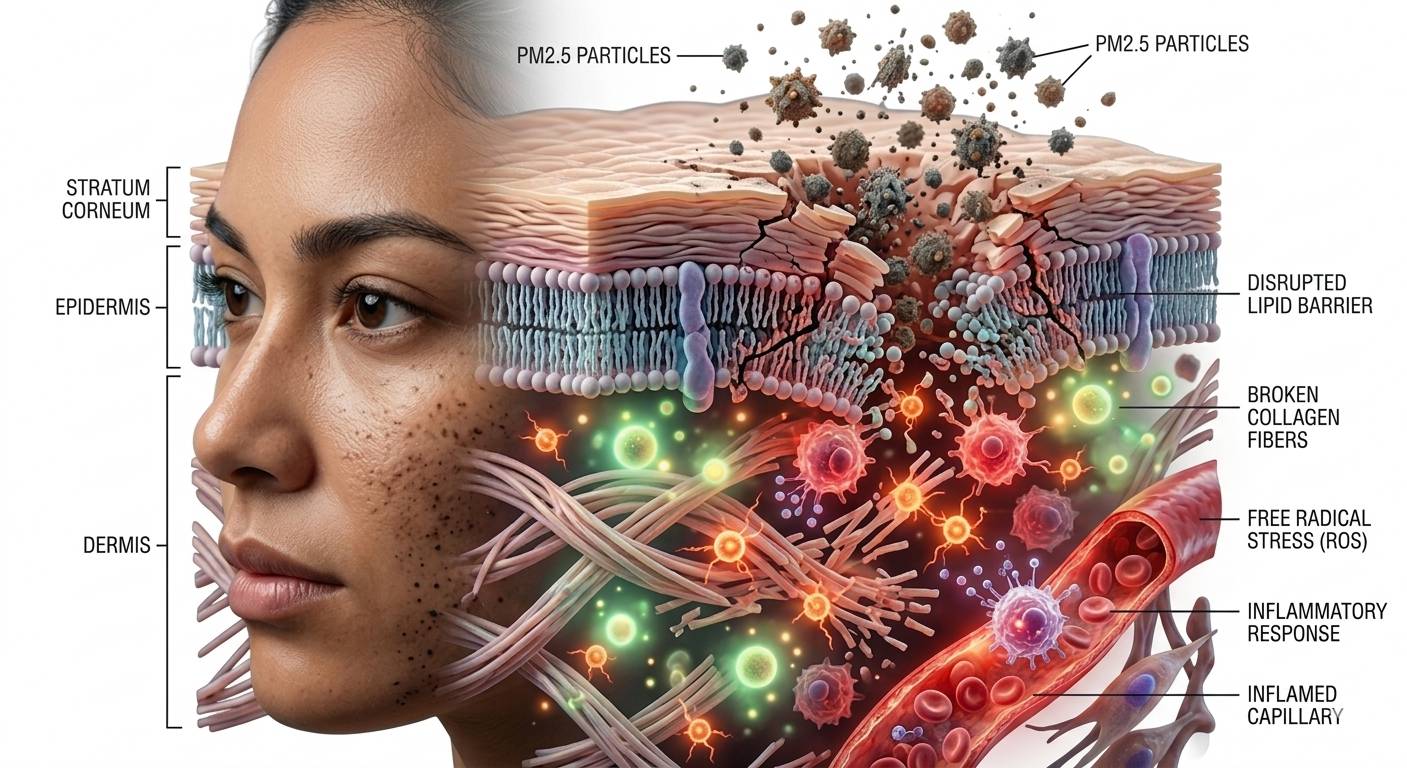
When we think of pollution, we often picture thick smog, billowing smokestacks, or the visible haze that hangs over a city skyline on a humid afternoon. However, the most dangerous pollutants for your skin are entirely invisible to the naked eye. The primary antagonist in the story of urban skin damage is particulate matter, specifically PM2.5.
To understand the threat of PM2.5, you have to understand its microscopic scale. A single strand of human hair is roughly 50 to 70 micrometers in diameter. A grain of fine beach sand is about 90 micrometers. PM2.5 refers to particulate matter that is 2.5 micrometers or smaller in diameter. These particles are roughly thirty times smaller than a human hair. Because they are so infinitesimally small, they do not just sit on the surface of your face; they easily infiltrate your pores, slipping past your skin’s natural defenses and plunging deep into the epidermis.
These tiny particles are essentially microscopic Trojan horses. They are often composed of toxic compounds, including polycyclic aromatic hydrocarbons (PAHs), volatile organic compounds (VOCs), and heavy metals from vehicle exhaust, industrial emissions, and even construction dust. Once inside your pores, they trigger a devastating biological chain reaction known as oxidative stress.
Fun Fact: Did you know that your skin "breathes" in its own way? While the lungs do the heavy lifting for oxygen exchange, the top layers of your skin absorb a small amount of oxygen directly from the air. Unfortunately, this means it also absorbs airborne toxins directly.
Oxidative stress occurs when there is an imbalance between free radicals and antioxidants in your body. Free radicals are highly unstable molecules missing an electron. In their desperate bid to stabilize themselves, they aggressively steal electrons from healthy cells, including the lipids, proteins, and DNA in your skin. When free radicals steal electrons from collagen and elastin—the proteins responsible for keeping your skin firm, plump, and youthful—they cause these structures to cross-link, become rigid, and ultimately break down. This biological vandalism manifests visibly as sagging skin, deep wrinkles, hyperpigmentation, and a dull, lifeless complexion.
Furthermore, pollution attacks the skin barrier itself. The stratum corneum, the outermost layer of your skin, acts as a protective brick-and-mortar structure. The "bricks" are skin cells, and the "mortar" consists of essential lipids like ceramides. Pollution degrades this lipid mortar. Once the barrier is compromised, microscopic fissures form. This allows essential moisture to evaporate into the air—a process known as transepidermal water loss—leaving the skin chronically dehydrated and vulnerable to even more environmental damage.
The Internal Saboteur: The Biology of Stress
While pollution mounts an external attack, chronic psychological stress launches a highly coordinated internal rebellion. The connection between the mind and the skin is not just poetic; it is hardwired into our biology. In the embryonic stage of human development, both the brain and the skin develop from the exact same layer of tissue, known as the ectoderm. Because of this shared origin, the skin and the nervous system remain intimately connected throughout our lives, communicating constantly through a complex network of neurotransmitters and hormones.
A Moment of Discovery: You have likely experienced the brain-skin connection without realizing it. Have you ever blushed from embarrassment, broken out in a cold sweat from fear, or developed hives during a period of intense anxiety? These are immediate, visible examples of your mind directly altering your skin's physiology.
When you experience stress—whether it is a looming deadline, a traffic jam, or a major life event—your brain triggers the hypothalamus-pituitary-adrenal (HPA) axis. This ancient survival mechanism was designed to keep our ancestors alive when facing physical threats, flooding the body with the primary stress hormone: cortisol. Cortisol prepares the body for "fight or flight" by redirecting blood flow away from non-essential organs (like the skin) and toward the muscles and vital organs.
In the modern world, however, we are rarely running from predators. Instead, we are dealing with constant, low-grade stressors that keep our cortisol levels elevated for days, weeks, or even months at a time. This chronic cortisol elevation is disastrous for your complexion.
First, cortisol binds to receptors in the sebaceous glands, commanding them to go into overdrive and produce excessive amounts of sebum (oil). This sudden influx of oil creates the perfect breeding ground for acne-causing bacteria, which is why stressful periods are almost always accompanied by painful, stubborn breakouts.
Second, elevated cortisol severely impairs the skin's ability to heal itself. It inhibits the production of hyaluronic acid, a natural sugar molecule that holds water and keeps the skin hydrated. It also accelerates the breakdown of existing collagen while simultaneously halting the production of new collagen. This dual-action sabotage accelerates the aging process, leading to the formation of fine lines and a loss of structural integrity.
Stress also triggers a systemic inflammatory response. Inflammation is the root cause of nearly every skin condition, from eczema and rosacea to psoriasis and adult acne. Chronic stress puts the immune system on high alert, causing the skin to become highly reactive, sensitive, red, and irritated.
The Perfect Storm: When Pollution Meets Stress

The true danger lies in the synergistic effect of stress and pollution. When a city dweller is exposed to both high levels of urban smog and high levels of psychological stress, the damage does not just double; it multiplies exponentially.
Consider the mechanics: Pollution aggressively depletes the skin's natural reserve of antioxidants, particularly Vitamin C and Vitamin E, which are the skin's primary defenders against free radicals. Under normal circumstances, a healthy body would work to replenish these antioxidants and repair the cellular damage overnight. However, if that same individual is under chronic stress, their elevated cortisol levels actively suppress the body's repair mechanisms.
The stress compromises the immune system and increases inflammation, making the skin even more susceptible to the toxic effects of the pollutants penetrating the pores. Simultaneously, the excessive oil production triggered by stress acts like a magnet, trapping even more particulate matter, exhaust, and dirt against the skin's surface. It is a vicious, self-perpetuating cycle of damage, inflammation, and accelerated aging.
Identifying the Silent Damage
Because the effects of stress and pollution accumulate gradually, many people do not realize their skin is under siege until the damage is severe. The symptoms are often misdiagnosed as simple aging or the use of incorrect skincare products.
One of the most prominent signs of environmental and stress-related damage is a pervasive dullness. Healthy skin naturally sheds dead cells and reflects light. However, when the skin is burdened by toxins and starved of nutrients due to stress-induced restricted blood flow, cellular turnover slows to a crawl. The result is a gray, lackluster complexion that looks perpetually tired, regardless of how much sleep you get.
Another indicator is increased sensitivity. If products that you have used for years suddenly start stinging, burning, or causing redness, it is a glaring sign that your protective lipid barrier has been breached by pollution and weakened by cortisol. You may also notice uneven texture, the sudden appearance of dark spots (as pollution triggers melanocytes to overproduce pigment in a defensive panic), and an increase in both dry, flaky patches and oily, congested zones.
The Ultimate Defense Strategy: Rebuilding the Barrier
Combating this modern dual-threat requires a comprehensive approach that addresses both the external environment and the internal physiological response. You cannot control the air quality of the city, nor can you eliminate all sources of stress from your life, but you can equip your skin with the tools it needs to defend and repair itself.
The foundation of any urban skincare defense is meticulous, intelligent cleansing. A splash of water and a harsh bar of soap will not suffice against microscopic particulate matter. You need a regimen that physically and chemically dissolves the trapped pollutants without stripping the skin of its essential oils. Double cleansing—starting with an oil-based cleanser to bind with and dissolve sebum, sunscreen, and smog, followed by a gentle water-based cleanser to wash it all away—is non-negotiable for city dwellers.
Equally important is an aggressive antioxidant intervention. Since pollution depletes your skin’s natural antioxidant reserves, you must replenish them topically. High-quality Vitamin C serums, applied in the morning, act as a vital shield, neutralizing free radicals before they can steal electrons from your collagen. Niacinamide (Vitamin B3) is another powerhouse ingredient; it not only acts as an antioxidant but specifically helps to repair a compromised lipid barrier, soothing the inflammation caused by both stress and environmental toxins.
Finally, hydration must be optimized. Because stress halts hyaluronic acid production and pollution causes transepidermal water loss, flooding the skin with moisture is critical. Utilizing rich, ceramide-heavy moisturizers will help seal the microscopic cracks in the skin barrier, locking hydration in and keeping urban dust out.
Professional Rescue: The Nakhon Spa Approach
While a rigorous at-home routine is your daily armor, surviving the modern urban environment requires professional reinforcement. Skincare products can only penetrate so deeply, and managing stress requires more than just a deep breath. This is where the therapeutic environment and advanced treatments of a dedicated wellness sanctuary become essential.
At Nakhon Spa, the approach to urban skin damage is holistic, recognizing that true radiance requires treating both the physical symptoms of pollution and the psychological roots of stress. The environment itself is engineered to immediately lower cortisol levels—the ambient lighting, the specific aromatherapy profiles, and the quiet serenity physically signal the brain to disengage the "fight or flight" response, allowing the body's natural healing mechanisms to reactivate.
For targeted, clinical-grade defense against urban pollution, advanced treatments like the HydraFacial are highly effective. A traditional facial often relies on manual extractions and topical creams, which, while beneficial, may not fully dislodge PM2.5 particles trapped deep within the pores. The HydraFacial, however, utilizes patented vortex-fusion technology.
Think of it as an elegant, fluid-based vacuum for your pores. It simultaneously cleanses, exfoliates, and extracts microscopic impurities, effectively pulling out the heavy metals, urban dust, and excess sebum that daily cleansers leave behind. Once the canvas is deeply purified and the barrier is cleared of toxic debris, the system forcefully infuses the skin with intensive serums packed with antioxidants, peptides, and hyaluronic acid. This not only reverses the oxidative stress caused by city living but deeply hydrates the tissue that cortisol has left parched. It is a total reset for pollution-weary skin.
Furthermore, integrating traditional therapies like a Thai massage into your wellness routine is not merely an indulgence; it is a vital countermeasure against the biochemistry of stress. Professional massage therapy has been clinically proven to significantly lower cortisol levels while simultaneously boosting serotonin and dopamine—the neurotransmitters associated with relaxation and happiness. By lowering the systemic stress response, you are directly reducing the inflammation and sebum overproduction that ravages your complexion.
Reclaiming Your Complexion
The reality of modern life is that stress and pollution are unavoidable variables. However, they do not have to dictate the health and vitality of your skin. By understanding the invisible microscopic warfare happening on the surface of your face, and acknowledging the profound biological impact of your daily anxieties, you can transition from a passive victim of your environment to an active defender of your health.
Armed with a protective, antioxidant-rich daily routine and supported by the advanced purification and stress-relief therapies available at Nakhon Spa, you can rebuild your skin barrier, neutralize the toxins of the city, and quiet the internal alarms. You can cultivate a complexion that is not only resilient to the demands of modern life but thrives in spite of them.